


Through the streams and forests of the Western Ghats, Anu and Mohit follow the elusive trail of the small-clawed otter and explore its wondrous ecosystem
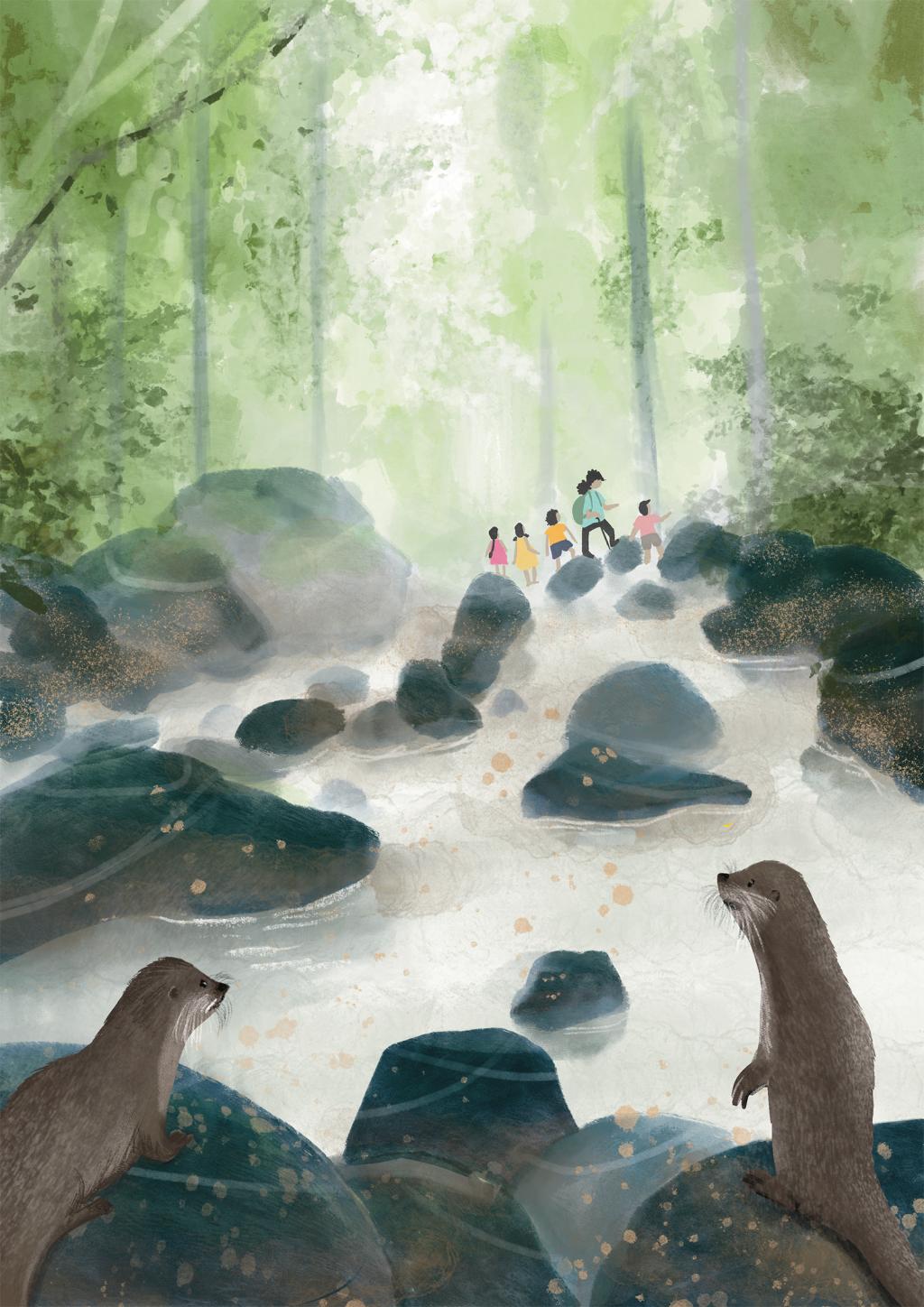
Anu and her young explorer friends follow the path of the stream as two small-clawed otters watch them from afar (illustration by Jayasri Sridhar)
Anu was taking notes in her square field journal when she noticed the little boy watching her. He stood silently among some large boulders to her left, his eyes keen and curious. Anu continued writing, gazing at the unusually slow section of the stream, covered with leaf litter floating in clumps and plastic bottles lining its edges. The soft buzz of insects rang out into the bright spring afternoon. She pretended not to have seen him but inwardly hoped that he would approach her. And he did.
For several minutes, he stood at a courteous distance, looking first at her notebook and then at the landscape she was observing. For her part, she angled it subtly towards him, signaling she didn’t mind his inquisitiveness. When he was close enough, Anu was glad to begin the conversation.
“Do you know who this land belongs to?” she asked the boy, nodding towards the sloping bank studded with coffee plants and a few trees but shorn of grasses and shrubs. The bank lay between the stream and the road above, by which she had parked her car.
“The stream,” he said, without skipping a beat. Anu blinked in surprise. Her degree had taught her all about riparian buffers—the trees, shrubs and grasses along streams that were the natural filters and stabilisers of this beautiful habitat. She had expected to hear him say that it belonged to the plantation owner who lived at the end of the road, but to hear this little boy in his cotton shorts and rubber chappals put it so simply, as if it was common sense, was refreshing. Anu would soon realise just how helpful her newest friend could be as she tried to understand the landscape and its residents.
Sensing that he was holding back questions of his own, Anu introduced herself and explained that her research on the small-clawed otter had brought her there. “Otter…” the boy let the word linger. She riffled through her journal and showed him some recent sketches she’d made of her favourite species. “Ah, the neernai!” Eyes twinkling, the boy flipped through her sketches, and with a shy smile, told her his name was Mohit.
“Can I show you around? I have known this stream since I was a baby,” he offered. Anu happily agreed, and, as they walked around, Mohit told her that he was in the sixth grade and that his family belonged to the Malaikudiya tribe that had lived there for centuries. As she looked up in awe at the massive trees, Mohit told her their local names, and interesting facts about their flowers and the bees they attracted—he knows so much! thought Anu.
When they were done, she invited him to join her survey the next day. She would be looking for fresh otter poop along the stream, because that was the best way to know how abundant they were here. Mohit smiled and nodded.
Trekking up the stream the next morning, Anu could barely keep up with Mohit’s nimble clambering. She also paused often to admire the dancing rays of the sun on the sparkling water and the fallen red leaves crowning the rounded rocks it flowed past.
“Here!” she exclaimed, pointing at the five pellets of fresh spraint atop a rock with tiny flies buzzing around it. Mohit bounded back to where she stood. A yellow butterfly that had been relishing the minerals in it fluttered away at the disturbance. Anu took some photographs, logged the location on an app and looked up, expecting to see her friend wrinkling his nose. Instead, Mohit stood bent, palms pressed to his knees, peering down intently.
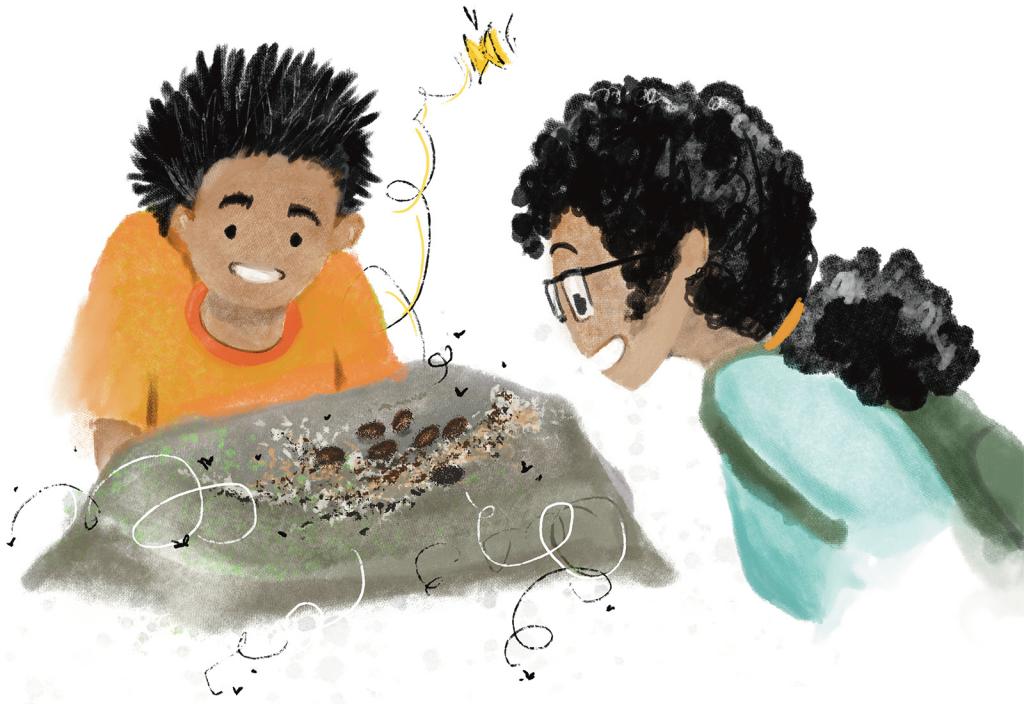
Anu and Mohit examine the otter spraint (illustration by Jayasri Sridhar)
“Why is it full of crumbled shells?” he asked. “That’s because these otters eat crabs and cannot digest shells,” explained Anu. “It almost looks like what the large owl we see here sometimes throws up,” Mohit said, frowning. He was referring to the brown fish owl, which also lives alongside streams and rivers.
“You’re right! Otter spraint and what owls regurgitate look similar, but spraints are well-formed, many in number and denser. Otter families tend to poop on rocky surfaces, using the scent to mark their territory!” Anu said.
They continued talking as they helped each other scale the steep sections of the stream where it fell in glistening rivulets. “I see a neernai from time to time. Just last month, there was one in our paddy field, about this big,” said Mohit, holding his hands about two feet apart. “But I didn’t know they lived in packs,” he added.
“Yes, they search for crabs in paddies! These otters live in packs of 5 to 7 individuals and are tightly knit as a family. You know, Mohit, their pups are playful and lively, and the mothers tend to be strict with them.” “Like my Amma!” said Mohit, making Anu chuckle. She was delighted with Mohit’s interest in her work. He had even spotted a couple of older spraint sites—with their powdery smattering of evidence—on his own.
Further upstream, they came upon a bunch of boulders stacked on each other, forming a cool, dark, deep den—a rock assemblage. “This is the perfect home for an otter family,” gestured Anu. “See this tree’s buttress roots? They’re almost like a grilled doorway!”
They decided to take a small break then and sat eating the bananas Anu had brought along. Sitting beside that likely den, they imagined a family of otters hiding deep inside and watching them. Somewhere above them, a Malabar whistling thrush called. Mohit whistled back in perfect imitation. The bird wasn’t visible, but its call told them it was there. Just like the spraint told them the otters were, too.
Over the next few days, Mohit rallied his friends from school to join in. Anu was now surrounded by half a dozen earnest, agile children, and a stream of questions. The company made Anu’s study of the other streams in the area much livelier.
“I wish there was a way to see them in the dark, when it’s their time to move about freely!” mused Bhavya. Anu opened her phone’s gallery, scrolled through an album, and showed her a black-and-white photo of a small-clawed otter with glowing eyes.
“How did you get that?!” the children exclaimed. “In our work, we carefully place cameras in places that do not disturb otters. These cameras take photos when they sense movement. The children stared at the photo in amazement. “Can we learn to use this camera?” Dinesh asked. “Of course, I can bring one the next time I come,” Anu reassured him.
As she covered the transects with her enthusiastic band, Anu began to see the larger mosaic of the ecosystem that her otters were a part of. She marveled at how her young friends had an eye for the loveliest of details—the spore patterns on the underside of ferns; brightly coloured beetles mating; water skaters skittering across the stream’s surface; a brittle snakeskin by their trail; lianas thick enough to swing on. They took turns looking through her binoculars, chattering and pointing things out to each other in hushed, excited tones.
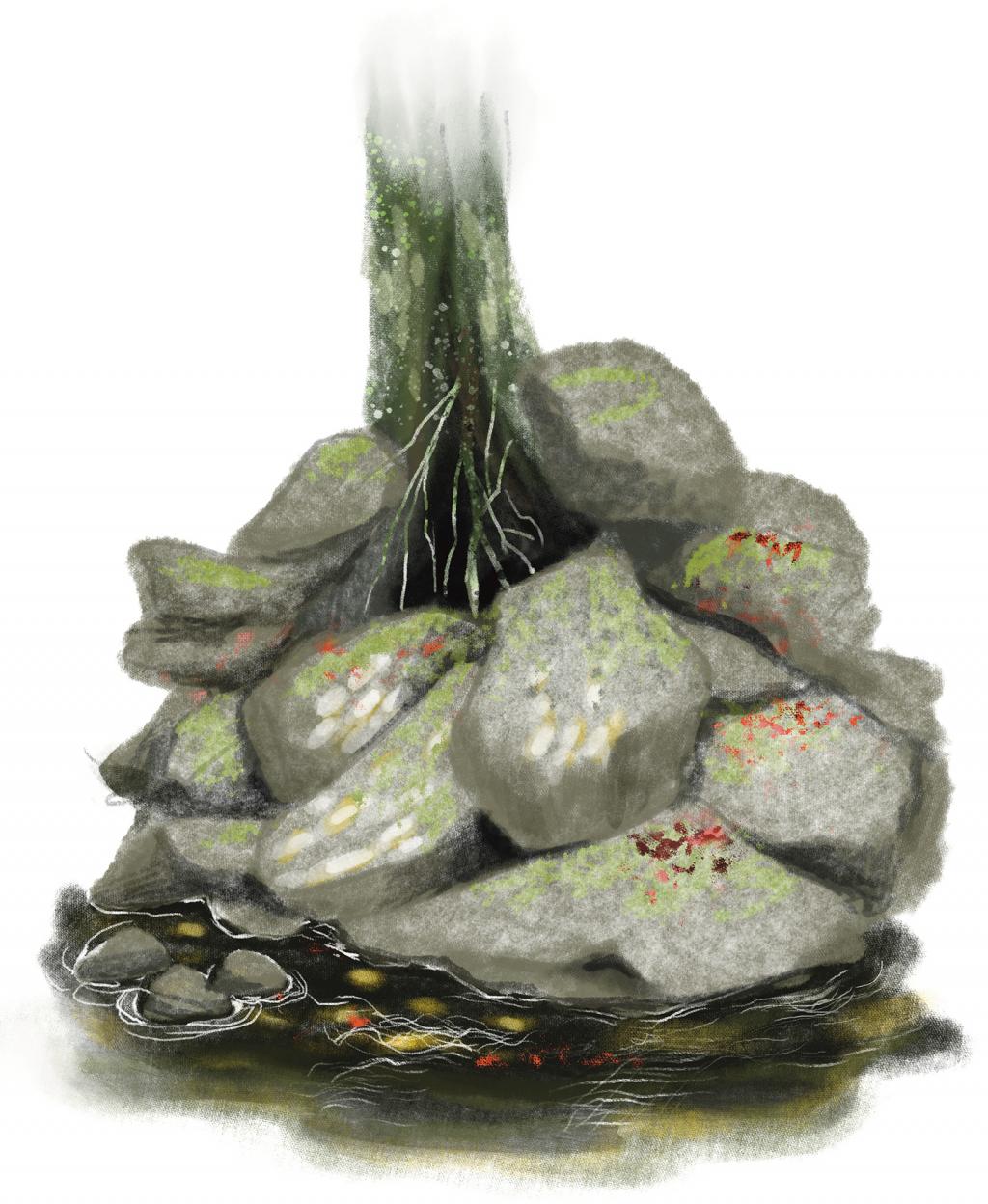
A rock assemblage—the perfect refuge for an otter family (illustration by Jayasri Sridhar)
“So this small-clawed neernai is among the top hunters of this place?” “Yes, that’s right, they’re called apex predators in English,” nodded Anu. “Still, that doesn’t mean they aren’t in danger…” she added with a frown. “From what, Anu akka?” the concerned children asked.
“Do you remember those plastic bottles we saw in the water earlier? They are empty bottles of chemicals that we humans unnecessarily use in agriculture and plantations. Weedicides, which are used to kill herbs and weeds, are among the most dangerous because they enter the stream, killing crabs and fish. When otters eat them, they get poisoned slowly as well.”
“So that means,” said the oldest girl in the group quietly, “when we humans drink this water, we are poisoning ourselves too.” Anu and the others thought about this for a moment. It was true.
When the last day of her survey came to a close, Anu was sorry at the thought of driving back to the city, where she would put on her glasses and write her report. The setting sun was a brilliant red. As she said her goodbyes to the children, all of them made her promise to return. Anu laughed as the smallest girl in twin pigtails chirpily demanded that she show up the next weekend.
“I’m sad you’re leaving without seeing an otter, Anu akka,” Mohit said. Anu shrugged, smiling. “That’s almost always the case in these surveys. I’m not sad though—I learned so much from being with you.”
Mohit squirmed at the compliment with a sheepish grin. “Do come back soon, Anu akka. We can then see how our neernai family is doing,” he said. “Until then, I’ll keep an eye out for them for you.”
1. Riparian Buffer
A strip of vegetation growing along the edge of a river or stream. It holds the bank, filters out pollutants and keeps the water shaded and cool enough for aquatic life to survive.
2. Abundant
Abundance refers to how many otters are present in a given stretch of river. As otters are shy and nocturnal, researchers estimate this by counting the signs they leave behind: spraint, footprints and feeding remains. The more signs per kilometre of riverbank, the higher the area’s otter abundance!
3. Otter Spraint
This is otter poop! Otters place spraint deliberately on rocks, logs and grass tufts to mark their territory and communicate with other otters. Otters often return to the same spots to use as their latrine. Otter spraint has a distinctively musky smell. Fresh spraint is dark, wet and jelly-like; older spraint dries out, fades and crumbles—helping surveyors tell how recently an otter passed through.
4. Minerals
Butterflies need minerals like sodium and potassium that nectar can't provide. To get them, they do what is called puddling—landing on wet mud, animal droppings or rotting matter to sip up the nutrients. This is mostly done by male butterflies, who later pass the minerals to females during mating to improve the chances of their eggs hatching.
5. Regurgitate
To bring food back up from the stomach and out through the mouth. Some animals do this to feed their young; others regurgitate indigestible parts like bones, fur or shells as compact pellets.
6. Rock Assemblage
A natural cluster of rocks. The cracks, flat surfaces and shaded gaps between rocks create dozens of small habitats—hiding spots for insects, basking platforms for reptiles and cool dark refuges for otters.
7. Transects
Fixed straight-line paths that researchers walk to survey wildlife, recording every animal, plant or track spotted within this set distance. Repeating this across seasons builds a reliable picture of how a population is changing over time.
8. Apex Predators
Animals at the very top of a food chain—they hunt others but are not hunted themselves. Their presence usually signals a healthy, intact ecosystem. Without them, the entire food chain can unravel.

She is a designer, filmmaker, researcher, hindustani vocalist and writer interested in social, ecological and more-than-human themes. A graduate of the National Institute of Design Ahmedabad, she has worked across social innovation, cultural production and wildlife conservation. Her projects have travelled to international conferences, film festivals and publications. Jayasri is presently crafting her own studio and welcomes creative collaborations and commissions. She can be found at jayasrisridhar.com.
He is the founder of The Otter Conservancy that works to conserve otters and their habitat, with a long-term ground project in the Brahmagiris across Coorg and Wayanad on small-clawed otters. The effort of The Otter Conservancy comprises working with children and with communities to restore riparian habitat and improve stream quality. Gopakumar also has an MBA from IIMB, is the author of two books of short stories and blogs regularly in the faint hope that someone somewhere would read his work. Read about his work at otterly-nuts.blogspot.com